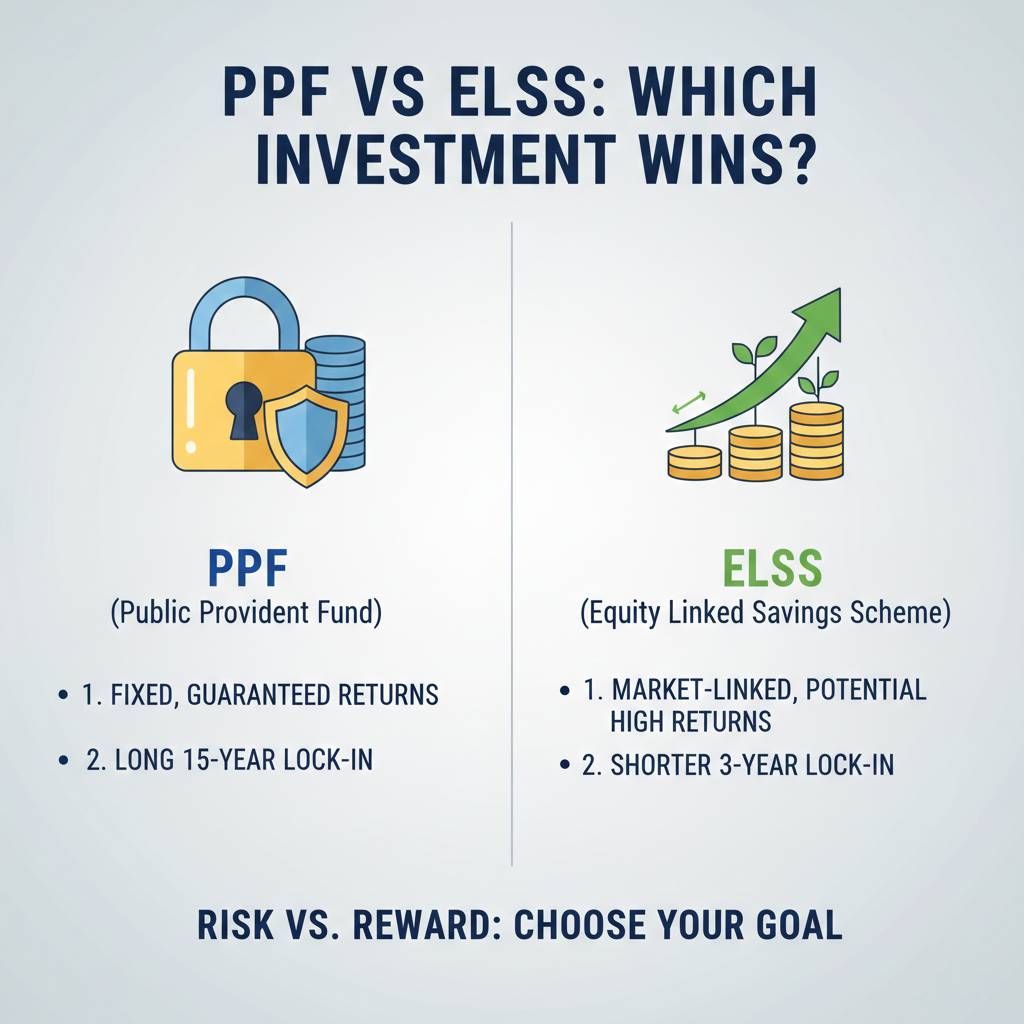
Every year, around late February or early March, the office atmosphere changes. People aren't just talking about deadlines or lunch plans anymore. They’re huddled around screens, frantically checking their Form 16s and wondering how to stop the government from taking a massive chunk of their hard-earned salary. It’s the "Tax Saving Season," and usually, the conversation boils down to a classic heavyweight fight: PPF vs. ELSS.
Most people treat this as a last-minute chore just a box to check under Section 80C. But if you’re looking at retirement, this isn't just about saving a few thousand rupees in tax today. It’s about what your life looks like twenty years from now. Are you going to be the person who can afford that quiet villa in the hills, or the one still worrying about the price of milk?
Let’s stop looking at these as just "tax savers" and start looking at them as the engines for your retirement.
YOU CAN ALSO READ:
Key signs of financial health auditThe Story of Two Colleagues: Safety vs. Speed
I remember two guys I worked with about a decade ago let’s call them Satish and Varun. They were both in their early 30s, earning roughly the same.
Satish was the "Sarkari Guarantee" guy. He didn’t trust the stock market. To him, the Sensex was just a gambling den. Every year, he would max out his ₹1.5 Lakh in the Public Provident Fund (PPF). He loved the feeling of that passbook entry. "It’s safe, the government is behind it, and the interest is tax-free," he’d say with a satisfied grin.
Varun was different. He was okay with a bit of "tension." He put his ₹1.5 Lakh into Equity Linked Savings Schemes (ELSS). He watched his portfolio value swing up and down. Some years he was up 20%, other years he was down 10%. Satish used to tease him during market crashes, saying, "See? My money is still there. Yours is evaporating."
The Reality Check 10 Years Later:
Fast forward a decade. Satish has a very respectable, safe pile of cash. It’s grown steadily at 7-8% (depending on the rates the government set each year). But Varun? Despite the crashes and the sleepless nights, his ELSS portfolio has compounded at roughly 14% annually.
Varun’s pile isn't just bigger; it’s significantly bigger. While Satish’s money kept pace with inflation, Varun’s money actually built wealth. This is the fundamental difference between "saving" and "investing."
Comparison Table: Breaking Down the Stats
Before we get into the "why," let’s look at the "what." Here is how these two stack up against each other.
| Feature | Public Provident Fund (PPF) | ELSS (Tax-Saving Mutual Funds) |
|---|---|---|
| Asset Class | Fixed Income (Debt) | Equity (Stocks) |
| Returns | Fixed (currently around 7.1%) | Market-linked (usually 12-15% long-term) |
| Risk Level | Zero (Sovereign Guarantee) | High (Market volatility) |
| Lock-in Period | 15 Years (Partial withdrawals after 6) | 3 Years (Shortest in 80C) |
| Tax Treatment | EEE (Exempt-Exempt-Exempt) | ETE (Exempt-Tax-Exempt)* |
| Best For | Capital Preservation | Wealth Creation |
The Tax Catch: PPF is the king of tax efficiency. You get a deduction when you invest, the interest is tax-free, and the maturity is tax-free. ELSS is almost as good, but since 2018, Long Term Capital Gains (LTCG) over ₹1.25 Lakh (as per latest budget updates) are taxed at 12.5%. Even with that tax, the sheer growth in equity usually beats the tax-free but lower returns of PPF.
Myth vs. Reality: Why "Safe" is Sometimes Dangerous
There’s a huge myth in India that PPF is the "best" investment because you can’t lose money. This is a half-truth. You won't lose the nominal value of your money. If you put in a lakh, you’ll get more than a lakh back.
But what about the real value?
The Reality of Inflation:
If your PPF is giving you 7.1% and the "real" inflation (the stuff you actually buy, like education, healthcare, and fuel) is at 6% or 7%, your wealth isn't growing. You are just standing still. For a retirement that might last 25-30 years, standing still is a death sentence for your finances.
Retirement is the most expensive thing you will ever buy. You need your money to grow faster than the cost of living. That’s where ELSS wins. By investing in the top companies in India, you are betting on the growth of the economy. Over 15-20 years, equity has historically outperformed every other asset class.
The Volatility Myth:
People fear ELSS because "the market could crash tomorrow." Sure, it could. But ELSS has a 3-year lock-in. For retirement, your horizon is likely 10, 15, or 20 years. On a 15-year scale, the "crashes" look like tiny blips on a chart that is mostly moving up and to the right.
The Numbers: A 20-Year Retirement Simulation
Let’s look at the math. If you invest ₹1.5 Lakh every year for 20 years:
- In PPF (assuming a constant 7.1%): You invest ₹30 Lakhs. Your corpus at the end is approximately ₹66 Lakhs.
- In ELSS (assuming a conservative 12%): You invest ₹30 Lakhs. Your corpus at the end is approximately ₹1.2 Crores.
That is a difference of ₹54 Lakhs. Think about that. For the exact same yearly investment, you could either have 66 Lakhs or 1.2 Crores. Which one makes your retirement look more comfortable? This is the power of compounding equity. It’s not about being "lucky"; it’s about having the stomach to stay invested through the ups and downs.
How to Choose (or How to Mix)
So, should you dump all your money into ELSS and forget about PPF? Not necessarily. Retirement planning isn't an "either/or" game. It’s about asset allocation.
How to decide your mix:
- Assess your age: If you are in your 20s or 30s, you have time on your side. You should be heavily tilted toward ELSS. You can afford the market swings.
- Check your EPF: If you are a salaried employee, a good chunk of your "debt" or "safe" investment is already happening via your Employee Provident Fund (EPF). Since you already have a "safe" component, you might not need much more in PPF. You can use your 80C limit for ELSS to balance things out.
- The "Sleep Test": If looking at a 10% drop in your portfolio makes you want to sell everything and hide under your bed, then ELSS shouldn't be your only tool. Keep a portion in PPF for your peace of mind. Safety has a psychological value that numbers can't explain.
Practical Tips: Getting the Most Out of Both
- Don't wait for March: The biggest mistake people make with ELSS is investing a lump sum in March. If the market is at an all-time high in March, you’re buying expensive. Start an SIP (Systematic Investment Plan) in ELSS from April. This way, you average out the cost throughout the year.
- The PPF "5th of the Month" Rule: If you are putting money in PPF, do it before the 5th of every month. The interest is calculated on the minimum balance between the 5th and the end of the month. If you deposit on the 6th, you lose out on interest for that entire month. It sounds small, but over 15 years, it adds up.
- Don't treat ELSS as a 3-year investment: Just because you can withdraw ELSS after 3 years doesn't mean you should. Treat it as a 10-year+ product. The real magic of equity compounding happens after the 7th or 8th year.
- Review your ELSS funds: Unlike PPF, which is a "set it and forget it" product, ELSS funds are managed by humans. Sometimes a fund that was a "star" five years ago might become a "laggard" today. Review your fund’s performance against its benchmark once a year. If it’s consistently underperforming for 2 years, it might be time to stop your SIP and start in a better-performing fund.
Misconception: "The New Tax Regime makes this irrelevant."
I hear this a lot lately. "Why bother with PPF or ELSS when the New Tax Regime doesn't give 80C benefits?"
Here’s my take: Tax saving is the bonus, not the purpose. Even if you move to the New Tax Regime, you still need to save for retirement. You still need an asset that beats inflation (ELSS) and an asset that provides stability (PPF). Don't let the lack of a tax break stop you from building a retirement corpus. The "cost" of not investing for retirement is much higher than the tax you save.
YOU CAN ALSO READ:
Understanding the Real Cost of a Mortgage.The Verdict: Who Wins?
If we are talking strictly about Wealth Creation for Retirement, ELSS is the clear winner. The math doesn't lie. Over long periods, equity is the only way for a middle-class person to build significant wealth.
However, if we are talking about Holistic Financial Health, a combination usually wins.
- Use ELSS as your primary wealth-building engine.
- Use PPF (or EPF) as your "Shock Absorber" the money that will be there regardless of what the US Fed or the RBI does.
At the end of the day, the "best" investment is the one that allows you to stay disciplined. If ELSS scares you so much that you stop investing altogether, it’s a bad investment for you. But if you can handle the ride, the rewards are life-changing.
Start today. Don't wait for the next tax cycle. Whether it's a ₹2,000 SIP in ELSS or a ₹500 deposit in PPF, the most important factor in retirement isn't the instrument it’s the time you give it.