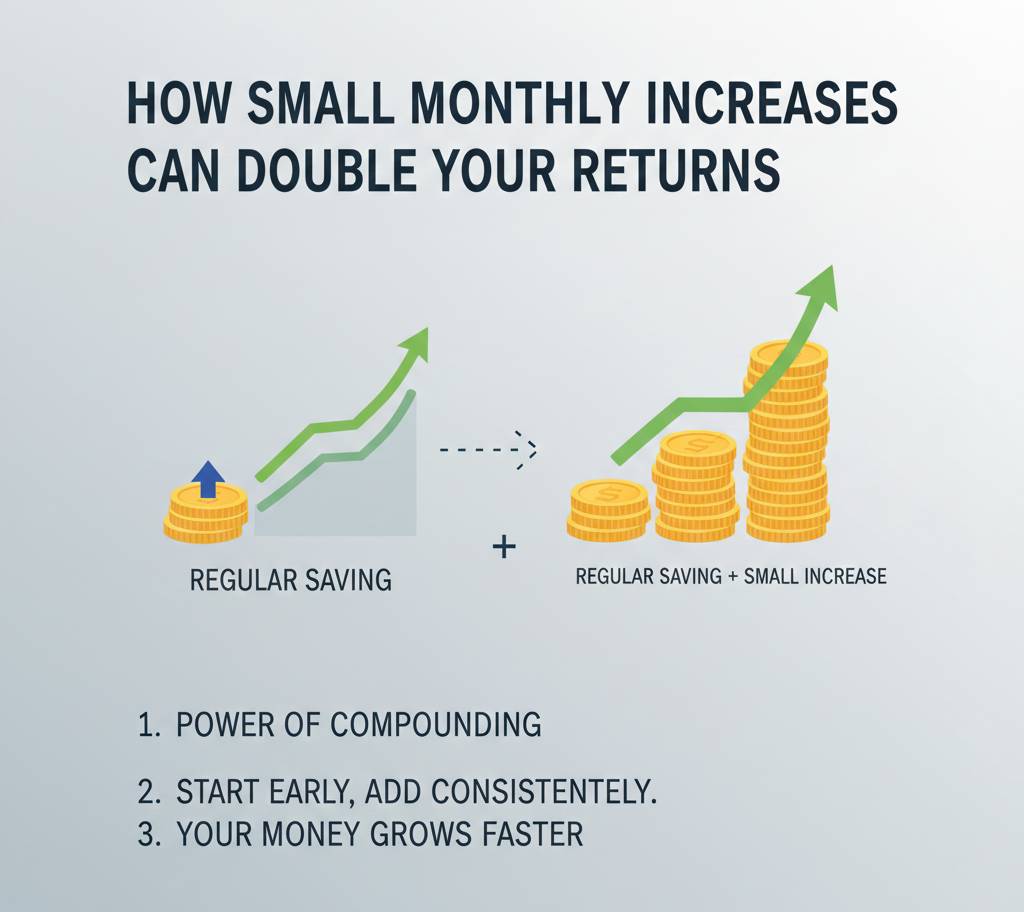
Most people start a Systematic Investment Plan (SIP) with a very "set it and forget it" mindset. You pick a decent mutual fund, set a monthly amount say ₹5,000 or ₹10,000 and then you basically ignore it for the next decade. You feel like you’ve checked the "financial planning" box. You’re done, right?
Not exactly. While starting an SIP is a great first step, leaving it at the same level for years is one of the biggest missed opportunities in wealth creation. It’s like going to the gym and lifting the exact same 5kg dumbbells for five years straight. Sure, you’re moving, but you aren't really getting any stronger.
The real magic doesn’t just happen through compounding alone; it happens when you feed that compounding engine more fuel as your income grows. This is what we call a "Step-up SIP," and honestly, it’s the closest thing to a financial superpower I’ve ever seen.
Myth vs. Reality: The "Fixed SIP" Trap
There is a common myth that if you just keep a ₹10,000 SIP going for 20 years, you’ll end up a multi-crorepath. People look at those generic compounding charts on Instagram and think they’re set for life.
The Reality: Inflation is a silent killer. A ₹10,000 SIP today feels like a significant amount. But in 15 years, thanks to the rising cost of petrol, milk, and rent, that same ₹10,000 will feel like pocket change. If your investment doesn't grow, your future wealth won't have the "buying power" you think it will.
The Numbers: Let's look at what happens when you keep things static versus when you push yourself just a little bit. Imagine you start an SIP of ₹10,000. We’ll assume a conservative 12% annual return over 20 years.
- Scenario A (Flat SIP): You stay at ₹10,000 for the full 20 years. You invest a total of ₹24 Lakhs. Your final corpus? Around ₹99 Lakhs. Not bad, right?
- Scenario B (10% Step-up): You start at ₹10,000 but increase it by just 10% every year. So, in Year 2, you pay ₹11,000. In Year 3, you pay ₹12,100. By the end of 20 years, your total investment is about ₹68 Lakhs, but your final corpus jumps to ₹2.2 Crores.
By simply increasing your contribution by 10% which usually matches a basic annual salary hike you more than double your final wealth. This isn't just "math"; it’s the difference between a comfortable retirement and a luxury one.
The Story of Two Colleagues: Rahul and Sameer
I remember two guys I worked with about a decade ago. Let's call them Rahul and Sameer. Both were earning roughly the same salary, around ₹60,000 a month at the time. Both were smart, disciplined, and decided to start an SIP of ₹10,000 in the same diversified equity fund.
Rahul was the "consistent" one. He set his SIP and never touched it. "Arre, it’s on auto-debit, why mess with it?" he’d say. He focused on his career, got promoted, and his salary eventually crossed ₹2 Lakhs a month. But his SIP stayed at ₹10,000. He used his extra income to upgrade his car, buy better iPhones, and take fancier vacations. His lifestyle grew, but his "future self" was still getting the same old ₹10,000.
Sameer, on the other hand, was a bit more calculated. He decided that every time he got a salary hike, he would divert at least half of that hike into his investments. He committed to a 10% annual step-up. When he got a ₹5,000 raise, he increased his SIP by ₹1,000 or ₹2,000. It didn't pinch him because he was still taking home more money than the year before.
Ten years later, they compared their portfolios over chai. Rahul was proud of his ₹23 Lakhs. He thought he’d hit the jackpot. Sameer, however, was sitting on nearly ₹45 Lakhs.
YOU CAN ALSO READ:
Key signs of financial health auditSameer hadn't sacrificed his lifestyle; he just made sure his "investment lifestyle" kept pace with his "spending lifestyle." Rahul had fallen into the trap of lifestyle creep where your expenses expand to swallow your entire income.
Why is 10% the "Magic Number"?
You might ask, "Why 10%? Why not 5% or 20%?"
In the Indian context, most corporate employees see an annual increment of 8% to 12%. If you increase your SIP by 10%, you are essentially saying, "I will live on my current standard of living and only use a small portion of my raise for extra comfort, while the rest goes to my future."
It’s also psychologically easier. If I tell you to double your SIP from ₹10,000 to ₹20,000 today, you’ll panic. You’ll think about your EMI, your kids' school fees, and your weekend outings. But if I tell you to increase it by ₹1,000 next year? That’s just a few Swiggy orders. It’s manageable.
The "Compounding on Steroids" Effect: When you increase your SIP, you aren't just adding money; you are buying more units of the mutual fund at different market levels. Over time, those extra units added in years 2, 3, and 5 have their own "compounding cycles" running. It’s like starting a new, smaller SIP every year on top of the old one.
Comparison Table: Flat vs. Step-up
Let's break this down further so you can see the sheer scale of the difference.
| Year | Monthly SIP (Flat) | Monthly SIP (10% Step-up) | Total Value (Flat @ 12%) | Total Value (Step-up @ 12%) |
|---|---|---|---|---|
| 1 | ₹10,000 | ₹10,000 | ₹1.28 Lakh | ₹1.28 Lakh |
| 5 | ₹10,000 | ₹14,641 | ₹8.2 Lakh | ₹10.3 Lakh |
| 10 | ₹10,000 | ₹23,579 | ₹23.2 Lakh | ₹37.5 Lakh |
| 15 | ₹10,000 | ₹37,974 | ₹50.4 Lakh | ₹1.02 Crore |
| 20 | ₹10,000 | ₹61,159 | ₹99.9 Lakh | ₹2.24 Crore |
Commentary: Look at the 15-year mark. The Step-up portfolio is already double the flat portfolio. By Year 20, the gap is almost ₹1.2 Crores! The extra effort in the early years seems small, but the "tail-end" results are explosive. This is why people who seem "average" earners often end up with massive wealth they just adjusted their contributions as they went along.
How to Implement a Step-Up SIP (The Practical Guide)
You don't need to manually go in and change your SIP every year. That’s too much work, and chances are you’ll forget or get lazy. Most modern investment platforms have made this "jugaad" very simple.
1. The Automatic Route:
- When you start a new SIP on platforms like Groww, Zerodha (Coin), or Kuvera, look for a checkbox that says "SIP Top-up" or "Step-up SIP."
- Select "Percentage" (usually 10%).
- Select "Frequency" (usually Yearly).
- Set a "Cap" if you want (e.g., "Stop stepping up once the SIP reaches ₹50,000").
Once you do this, the bank will automatically increase the mandate. You don't have to lift a finger for the next decade.
2. The Manual "Appraisal Ritual":
If your platform doesn't support automatic top-ups, make it a ritual. Every year, during your performance appraisal month (usually April or July), log into your account.
- Calculate 10% of your current SIP.
- Either modify the existing SIP or simply start a new SIP for that 10% amount in the same fund.
- Treat it like a "tax" you pay to your future self.
YOU CAN ALSO READ:
Why your interest rate isn't the full story3. The Windfall Strategy:
Sometimes you get a bonus or a sudden tax refund. Instead of blowing it all on a new gadget, use a portion of it to increase your SIP by an even larger margin. Even a one-time jump of 20% in one year can drastically pull your "financial freedom" date closer.
Common Mistakes to Avoid
While the math is simple, the execution can be tricky. Here are a few things I’ve seen people mess up:
- Not Setting a Cap: If you start with a ₹50,000 SIP and do a 10% step-up, in 20 years your monthly SIP would be over ₹3 Lakhs. That might not be sustainable! Always have a realistic "ceiling" in mind based on your expected peak career earnings.
- Neglecting the Emergency Fund: Don't get so aggressive with your SIP increases that you leave yourself with zero cash in the bank. If a medical emergency hits and you have to break your SIP, the whole compounding chain snaps.
- Focusing Only on Large Caps: As your SIP amount grows, you might want to diversify. A ₹10k SIP in one fund is fine. A ₹1 Lakh SIP should probably be spread across a Nifty 50 Index fund, a Mid-cap fund, and maybe some international exposure.
A Final Reality Check
Look, we all want the "big life." We want the villa, the luxury cars, and the stress-free retirement. But most of us try to get there by looking for "multibagger" stocks or the "next big crypto." We look for shortcuts.
The 10% step-up isn't a shortcut. It’s a disciplined, boring, and mathematically certain way to reach your goals faster. It works because it forces you to prioritize your future self over mindless consumption today.
Next time you get a hike, don't just celebrate with a party. Celebrate by logging into your investment app and bumping up that SIP by 10%. Your 50-year-old self will thank you for it probably from the balcony of a much nicer house than you ever imagined.